Why the mounting hardware carries more weight than people think
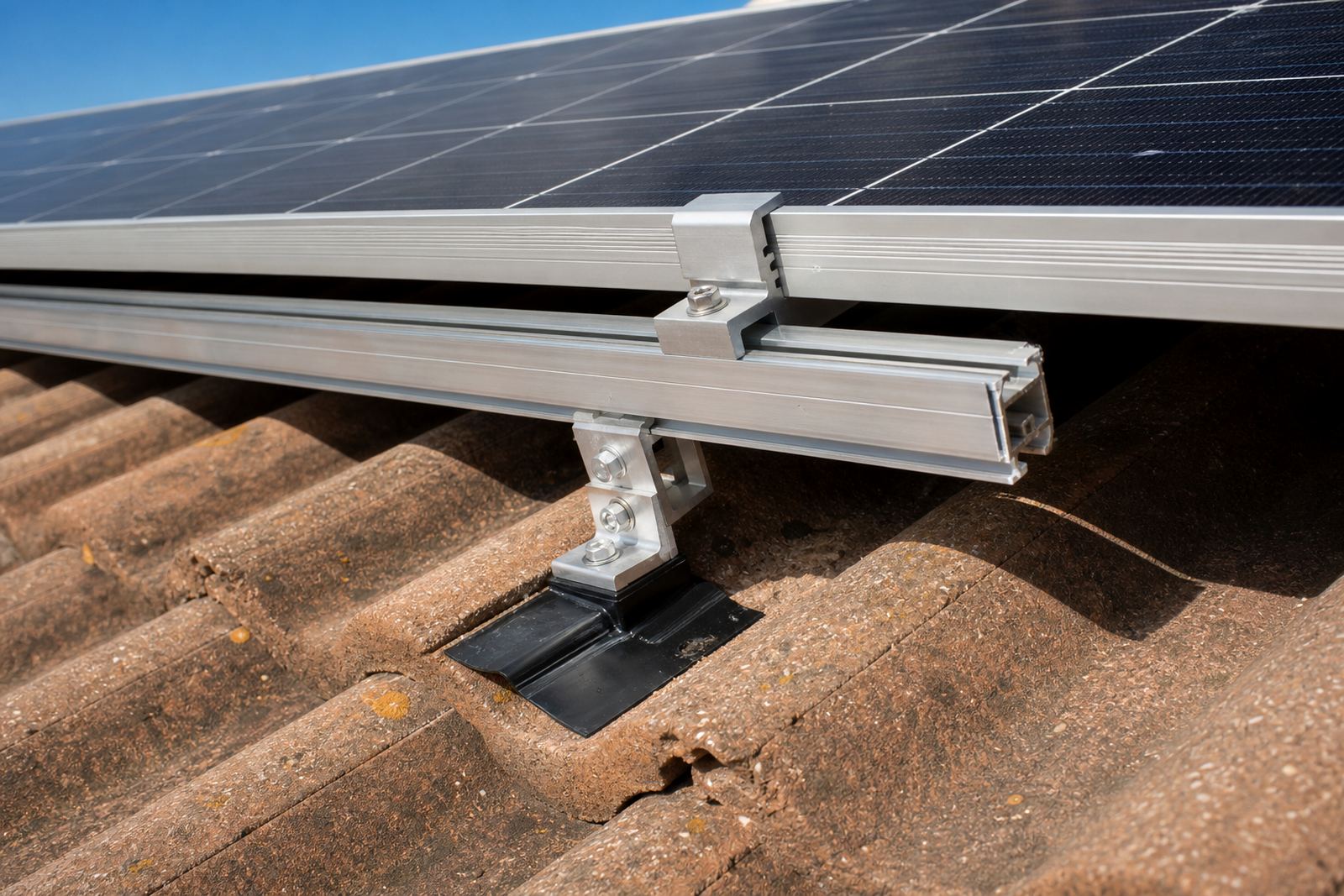
Solar panels are only as secure as the structure holding them in place. On a roof, the mounting system must deal with uplift from wind, expansion and contraction in summer heat, and the constant vibration that comes with daily weather changes. If the rails are out of line or the clamps are under tight, the system can shift over time and that puts the roof and the panels at risk.
In practical terms, good mounting is about keeping the array level, evenly spaced and fixed to suitable roof points. The installer must also check the roof material, whether it is concrete tile, IBR sheeting, zinc or a flat roof with a framed support structure. A neat finish matters, but strength and correct spacing matter more.
- Rails must be fixed to suitable roof anchors or support points.
- Clamps should grip the panel frame evenly without crushing it.
- Fasteners need to suit the roof material and the local weather.
- Clearances should allow for airflow under the panels.
Rails, clamps and the small parts that stop big problems
Rails create the straight line that panels sit on, while mid and end clamps hold each panel in position. Those parts may look simple, but they are doing a lot of work. When a roof is exposed to strong wind, especially in open areas around Gauteng or coastal suburbs where salt air is a factor, a loose clamp can become a serious issue. Rust and corrosion are not just cosmetic problems they shorten the life of the whole system.
That is why quality mounting hardware should be chosen with the roof and environment in mind. In Durban or Cape Town, for example, coastal humidity can be hard on cheap metal parts. Inland in Pretoria and Centurion, intense heat and sudden storms can test fixings that were never tightened correctly in the first place.
- Use corrosion-resistant fixings where the environment calls for it.
- Keep rails straight so the panels sit flat and evenly loaded.
- Use the correct clamp type for the panel frame thickness.
- Check every fixing after final tightening and before commissioning.
A secure roof mount protects more than the panels
People often focus on the glass and cells, but a failed mounting point can damage tiles, sheeting, insulation and ceiling boards below. On a residential roof that means leaks and repair costs. On a small business roof it can mean downtime, water damage to stock or equipment and extra strain on operations during load-shedding when the system is needed most.
A properly mounted solar array also helps with airflow. Panels mounted too close to the roof can run hotter, and higher temperatures are not friendly to performance. A proper gap allows air movement underneath, which supports better operating conditions and helps the installation stay cleaner and easier to inspect.
For many Pretoria homes, especially those with older tiled roofs, secure mounting starts with checking the roof structure before any drilling or fixing happens. The roof has to be sound first. If it is not, the installer should say so before the job moves ahead.
What a careful installer checks before lifting a single panel
At Linuo Solar, site assessments are part of the process because every roof is different. A good installer does not guess where the rails will go. The team checks roof slope, shade from nearby trees or parapets, access for maintenance and the condition of the roof covering. Electrical work is done by qualified installers, and the same careful approach should apply to the mechanical side of the job too.
The aim is to match the system to the building, not force the building to suit the system. That means checking load points, confirming fixing positions and making sure the route for cables is tidy and protected from abrasion. It also means planning for future work such as panel cleaning, fault finding and maintenance callouts.
- Roof condition and fixing points are inspected before installation starts.
- Shading and access are considered in the layout.
- Cable paths are planned to avoid sharp edges and movement points.
- The finished array is checked for alignment and stable clamping.
Local weather means local fixing choices matter
South African roofs face a mix of weather patterns. Pretoria can see hard summer storms and strong sun. Johannesburg brings dust and seasonal rain. Bloemfontein has dry heat and sudden weather shifts. Durban has humidity and salt in the air. Cape Town can bring wind that tests every loose point on a roof. That is why mounting cannot be treated as a one size fits all job.
The right mounting layout takes those conditions into account. On some roofs the fixings need to be spaced with care to spread the load. On others, extra attention is needed around ridge lines, edges and areas where uplift is strongest. In every case, the installer should think about long term service, not just how the job looks on day one.
A well secured installation stays quieter too. When rails and clamps are correctly fitted, there is less movement, less rattling and fewer problems during storms. That gives the owner more confidence when the weather turns rough.
How Linuo Solar approaches mounting on homes and small business roofs
Our work across Pretoria, Centurion, Johannesburg, Midrand, Durban, Cape Town, Bloemfontein and the wider Gauteng area is built around practical installation. We supply and install solar panels and solar water heaters for homes and small businesses, and the mounting stage gets the same attention as the electrical connection and commissioning. Vuyo Phasha leads the business from our base in Centurion, Pretoria, with support from Naledi Kgosi, Sarel Delport, Palesa Mabena, Mothusi Mphahlele, Faatimah Latief and Unathi Tau.
The team handles site assessments, system design, panel installation, inverter installation, battery installation, water heater installation, electrical integration, system commissioning, solar maintenance, fault finding, panel cleaning and support callouts. That full service matters because a mounting fault often shows up later as a panel issue, a cable strain problem or a noisy roof. Catching those details early saves time and avoids repeat visits.
If you are planning a rooftop system, ask the installer how the rails will be fixed, what type of clamps will be used and how the roof will be protected. The best answer is clear and specific, not vague. Good solar mounting should be built to last, not just built to pass the day of installation.